ClippingCommentary
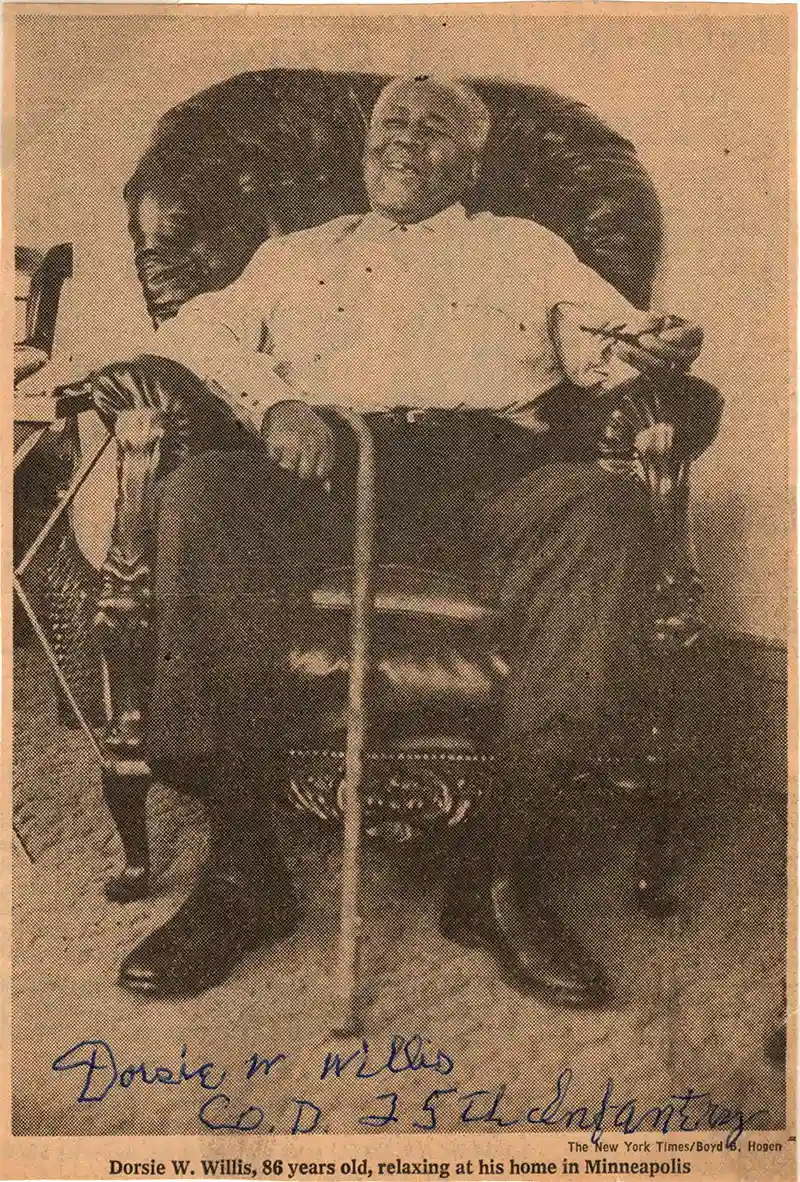
Dorsie W. Willis, signed clipping
The only survivor of the 1906 Brownsville discharges to receive his correction in person, photographed at home in Minneapolis at eighty-six. He has signed the clipping across the photograph in blue ink — “Dorsie W Willis, Co. D. 25th Infantry” — naming the company he was expelled from without charge or trial.
- Date
- 31 December 1972
- Publisher
- The New York Times
- Collection
- Holdings
About the object
Willis was a private in D Company, First Battalion, Twenty-Fifth Infantry, and was nineteen when the discharge order of 9 November 1906 reached him. He shined shoes in the barber shop of the Northwestern Bank Building in Minneapolis for fifty-nine years. He was eighty-six when the Army corrected the discharges and called the incident a gross injustice.
He had lost his own discharge certificate years earlier, and recited its wording from memory to a reporter: discharged from the Army of the United States without honor, and forever debarred from enlisting in the Army or Navy or from holding any civilian employment under the Government. A check of his file at the National Archives showed his memory was exact.
The case is set out at Brownsville: discharged without trial.
Provenance
Held by the Institute. A clipping of the photograph published in The New York Times on 31 December 1972 with Andrew H. Malcolm’s interview, signed by Dorsie W. Willis, mounted, and annotated in a later hand “Sole survivor of the Brownsville Massacre 1906” and “1974.” Photograph by Boyd B. Hogen. The signature is likely to date from 1974, when Willis was again in the news; that is an inference from the annotation and not established.
Cite this record
Dorsie W. Willis, signed clipping, 31 December 1972. Holdings, Institute for Constitutional Military Law, https://icml.us/holdings/dorsie-willis-signed-clipping-1972/