Dorsie W. Willis
U.S. Army, Twenty-Fifth Infantry
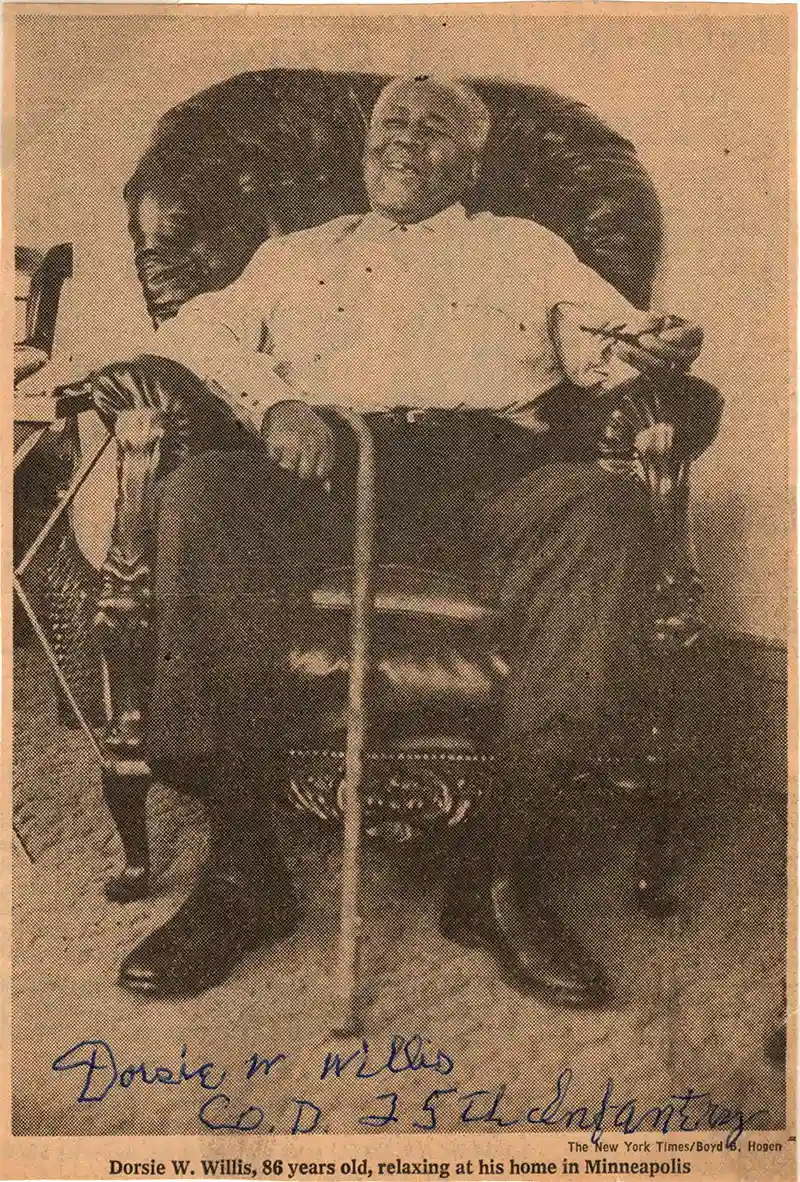
Dorsie W. Willis was a private in the Twenty-Fifth Infantry, one of 167 Black soldiers discharged without honor in 1906 for a shooting no one ever proved any of them committed. No one charged him. No one tried him. For the next sixty-six years he carried that discharge, and it kept him out of any job that asked for references. He lived to see the Army call it a gross injustice, to receive his honorable discharge and an apology, and to tell Congress what it had cost him.
Brownsville, 1906
On the night of August 13, 1906, shots were fired in the streets of Brownsville, Texas. One man was killed. The townspeople blamed the Black soldiers of the Twenty-Fifth Infantry at Fort Brown. The Army investigated twice and could not name a single man who fired. It concluded that the soldiers were protecting one another.
On November 9, 1906, by the President’s direction, practically every enlisted man in the garrison was discharged without honor. Willis was a private in Company D. There were no charges and no court-martial. The government’s own account, decades later, admitted that “it proved impossible to establish the guilt of individual soldiers.”
The whole case is told on Brownsville: discharged without trial.
The paper he never forgot
He lost his discharge paper years later. He never forgot what it said. In 1972, at eighty-six, he squinted and recited it for a reporter from memory.
“Dorsie Willis is hereby discharged from the Army of the United States without honor and forever debarred from enlisting in the Army or Navy of the United States or holding any civilian employment under the Government.”Dorsie W. Willis, to The New York Times, December 31, 1972
A check of his file at the National Archives showed his memory was exact.
Fifty-nine years with a shoeshine brush
Willis made his life in Minneapolis. In 1913 he started shining shoes in the barber shop of the Northwestern Bank Building, for a dime and a tip. He opened the shop every morning, swept the hair off the floor, brushed the lint off customers’ coats and closed it at night. He did that for fifty-nine years. He supported his wife, raised his son and, at fifty, went $2,850 into debt to buy his own house.
“That has kept me from getting any kind of a job where I had to furnish references. It forced me into shoe shining.”Dorsie W. Willis, to the Los Angeles Times, December 2, 1972
“Some people feel the world owes them a living. I never thought that. And I never took a dime in welfare. I did figure the world owed me an opportunity to earn a living myself. But they took that away from me. That dishonorable discharge kept me from improving my station. Only God knows what it did to the others.”Dorsie W. Willis, to The New York Times, December 31, 1972
Willis said “dishonorable.” In law it was a discharge without honor, given with no court-martial. That difference mattered a great deal to the War Department and not at all to an employer asking for references.
Honor restored
On September 28, 1972, the Secretary of the Army, Robert F. Froehlke, called Brownsville a gross injustice and changed all 167 discharges to honorable. The Army made no effort to find the men. It presumed they were all dead.
Then a newspaper story about Willis and his poverty appeared. Readers, among them a class at New York City’s High School of Music and Art, sent him several hundred dollars for medicine. The Army sent a team to Minneapolis to confirm who he was. On February 11, 1973, at a public ceremony, the Army gave him his honorable discharge and its apology.
“Mr. Willis, you honor us by the quality of the life you have led, by your outstanding citizenship and by the faithful service you rendered the United States Army.”Maj. Gen. DeWitt Smith, U.S. Army, February 1973
They gave him a flag. Willis said he would keep it “to put on my coffin.”
He told Congress
On June 14, 1973, Willis testified before the House Committee on Veterans’ Affairs.
“My discharge barred me from enlisting in the Army and Navy of the United States and the Government. And it prohibited me from holding a job, if it was anything that I was qualified to do. Nobody would put up a bond for me. It barred me from any citizen’s rights…. It was unjust. I was kicked out of the Army without a trial and my citizenship taken away from me…. I have never been tried.”Dorsie W. Willis, House Committee on Veterans’ Affairs, June 14, 1973

Too many years too late
Representative Augustus F. Hawkins of California pressed for compensation. On December 6, 1973, President Nixon signed a law paying $25,000 to any surviving Brownsville soldier. Willis was believed to be the only one left.
Col. William Baker of the Army handed him the check in Minneapolis on January 10, 1974.
“I’m very grateful (for the check). It’s a great birthday present. But it comes too many years too late.”Dorsie W. Willis, to United Press International, January 10, 1974
He died in August 1977, at ninety-one.
Why he is on this wall
The government branded Dorsie Willis with a discharge it never had to justify. He did not let that paper decide who he was. He worked every day, kept his family and paid for his home. And when the country finally asked, he told it the truth in plain words. “I was kicked out of the Army without a trial.”
A nation needs heroes. Dorsie W. Willis is an American hero.
From the Archive
The Institute holds the original press prints below. Each one is in the Archive, front and back, with its caption and stamps transcribed.


Sources
- Brownsville: discharged without trial, the Institute’s case study, with the documents it rests on
- “At 86, Black Resentful of Army Action in Texas Raid,” The New York Times, December 31, 1972
- Los Angeles Times, December 2, 1972, as quoted on the Brownsville page
- “Army Clears 167 Black Soldiers Disciplined in a Shooting in 1906,” The New York Times (AP), September 29, 1972
- “Army Returns Honor To Discharged Black,” The New York Times, February 12, 1973
- House Committee on Veterans’ Affairs, Brownsville Incident hearing, June 14, 1973, pp. 1215–1240
- Act of December 6, 1973, Pub. L. No. 93-177, § 7, 87 Stat. 696–697
- United Press International, Minneapolis, January 10, 1974
- “Dorsie W. Willis, 91, Victim of Army Bias,” The New York Times, August 25, 1977
- Department of Veterans Affairs, 61 Fed. Reg. 11309 (March 20, 1996)