Wall of Heroes
Some of the people on this wall were given a discharge meant to mark them for life, and refused to let it decide who they were. Others stood up for them, senators, lawyers and officers who saw the injustice and fought to end it. These are their stories, told from the court records, the congressional record and the newspapers of their day, and in their own words wherever we have them.
A nation needs heroes.
Service members and veterans who were branded by it, and refused to let it decide who they were. Senators, representatives, lawyers and officers who saw the injustice and fought to end it.They bore the discharge
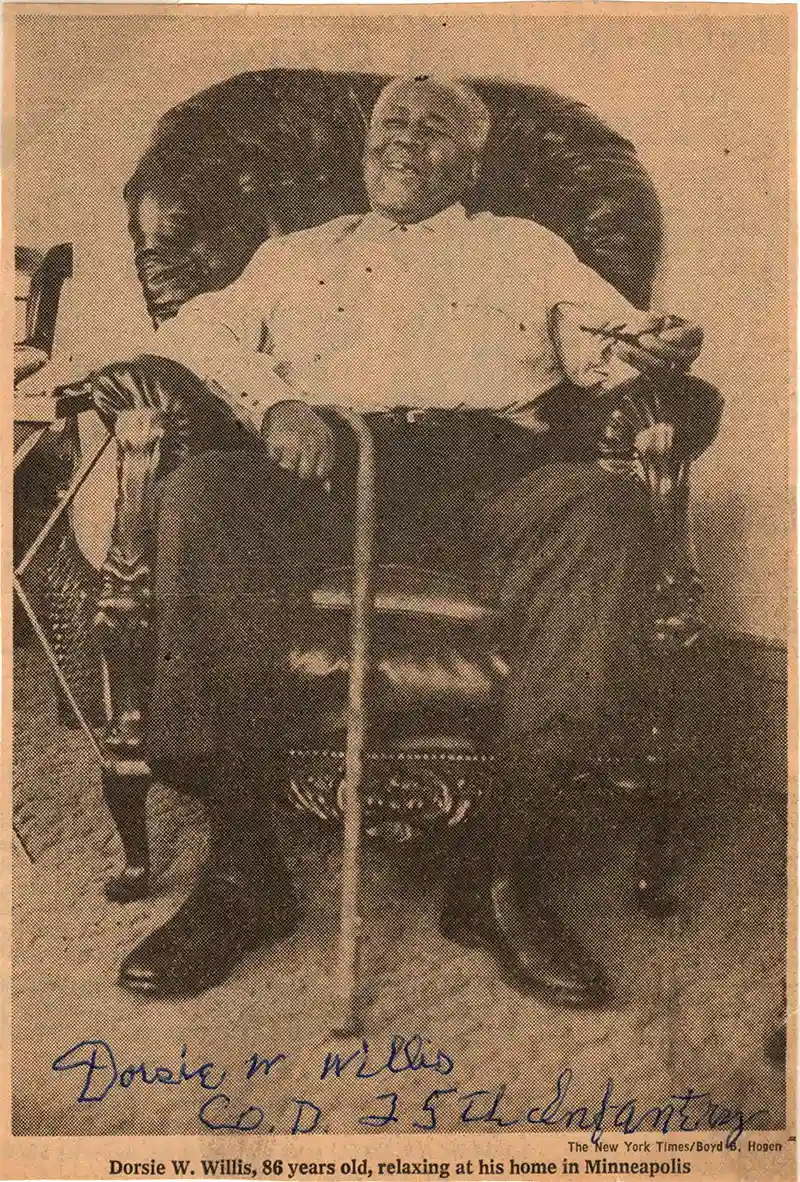 Dorsie W. WillisU.S. Army, Twenty-Fifth InfantryDischarged without honor after Brownsville with no charge and no trial. He shined shoes for fifty-nine years, lived to receive his honorable discharge, and told Congress what it had cost him.
 Mingo SandersU.S. Army, 1881–1906A first sergeant with twenty-five years in the Twenty-Fifth Infantry, thrown out without a trial after Brownsville, who spent the rest of his life asking his country to give his honor back.
 Fannie Mae ClackumU.S. Air Force (WAF), 1951–1952Accused of homosexuality in 1951, she refused to resign and demanded a court-martial to face her accusers. The Air Force refused and gave her an other than honorable discharge. In 1960 a federal court ruled the discharge invalid.
 Howard D. AbramowitzU.S. Army, 1951–1953A Korean War soldier branded years after his honorable service for the politics of his youth, who won beside Harmon in the Supreme Court.
 John Henry Harmon IIIU.S. Army, 1952–1954Drafted, rated excellent, and thrown out as a security risk for his life before the Army. He took the Army to the Supreme Court, won, and became a lawyer who defended others the government had marked.
 Perry WatkinsU.S. Army, 1967–1984Drafted after telling the Army he was gay, re-enlisted three times, then thrown out under a new rule. He fought nine years, won, and the Supreme Court refused to hear the Army’s appeal.
 John W. Shepherd Jr.U.S. Army, 1968–1969A Bronze Star soldier discharged for the wound no one could see, who fought the Army for forty years and won.
 Conley F. Monk Jr.U.S. Marine Corps, 1968–1970A Vietnam Marine who signed for an undesirable discharge in a brig on Okinawa, then spent fifty years leading the fight for veterans, from the Hagel memo to the courts.
 John RoselliU.S. Marine Corps, 1968–1970An excellent Marine who went home to his failing parents after his best friend was killed in Vietnam. Navy psychiatry recommended an honorable-conditions discharge. A President pardoned him. He is still asking his country to call his service honorable.
 Barbara BaumU.S. Marine Corps, 1985–1990A military policewoman and honor graduate, court-martialed and jailed in the Parris Island purge. She fought the conviction, won on appeal, and left with an honorable discharge.
 Judy MeadeU.S. Marine Corps, military policeA Marine officer of twelve years whom five colonels moved to brand for a friendship. She asked for a court-martial, never got one, and won on review.
 Dr. Britt StuessyU.S. Navy, 2008–2010A Navy sailor sent home with an Other Than Honorable discharge who refused to be defined by it. She earned a doctorate, won her upgrade to Honorable in 2025 and now fights for the sailors and Marines still waiting.
They stood with them
 Joseph Benson ForakerU.S. Senator from Ohio, 1897–1909He stood up for the men of the Twenty-Fifth Infantry. “They ask no favors because they are negroes, but only for justice because they are men.”
 Samuel T. AnsellU.S. Army, 1899–1919The Army's senior lawyer through most of the First World War, he fought to undo dishonorable discharges imposed in violation of law and insisted that a soldier's honor must answer to law, not to command.
 Sam J. Ervin Jr.U.S. Senator from North Carolina, 1954–1974For more than twelve years he fought to bring the administrative discharge under the law, and told the Senate the services answered only to their own regulations.
 Charles E. BennettU.S. Representative from Florida, 1949–1993For a quarter century in the House he fought the stigma of the less than honorable discharge, and told Congress that no statute had ever authorized the general or undesirable discharge.