The Brownsville Affray Records
Every document and record of the Brownsville discharges, 1906 to 1972
On the night of August 13, 1906, shots were fired in Brownsville, Texas. Within three months President Theodore Roosevelt had discharged without honor 167 Black soldiers of Companies B, C and D of the Twenty-fifth Infantry. Not one was charged. Not one was tried. Congress investigated, two officers were court-martialed, a Court of Inquiry sat for more than a year, and in 1972 the Army changed the discharges to honorable. Every step is in the printed record. This is where the Institute keeps all of it.

The story
What happened
During the night of 13–14 August 1906, shots were fired in the streets of Brownsville, Texas. The firing appeared to be at random. One man was killed and several were wounded. It was the general belief of the townspeople that soldiers of the Twenty-Fifth Infantry, stationed at Fort Brown next to the town, had done it.
The Army investigated twice, the second time on the President's own order. The Inspector General reported that careful investigation had established that the firing was done by unidentified enlisted men of the Twenty-Fifth, and that the men of the command had failed to tell all it was reasonable to believe they knew. They “appeared to stand together,” he wrote, “in a determination to resist the detection of the guilty.”
What the government ordered
On that report, an order was issued by the President's direction on 9 November 1906 discharging without honor practically every enlisted man in the garrison. The men were barred from re-enlisting in the Army or the Navy. They were granted travel pay.
A second order five weeks later allowed a discharged man to apply for re-enlistment — if he submitted written evidence that he had not been implicated in the shooting and had withheld nothing that might lead to the discovery of whoever had. Each application went to the War Department for consideration and investigation before any recruiting officer could act.
That is the shape of the thing. No individual accusation had been made against any of the 167. To undo the consequence, each man was nonetheless required to prove his own innocence to the department that had punished him.
What process the soldiers received
None. There were no charges, no court-martial, no individual finding of fact against any man discharged. The instrument used was the blank form created thirteen years earlier by an Adjutant General's circular, which authorized discharge “without honor” in four cases, only one of which involved a court-martial.
What a court said
Oscar W. Reid enlisted in July 1904 and swore to serve three years “unless sooner discharged by proper authority.” He was at Fort Brown on the night of the shooting. After his discharge he sued for the pay he would have earned over the remainder of his enlistment.
Judge Hough set aside as immaterial whether Reid or any of his comrades was guilty, whether Reid had committed any infraction at all, whether he knew or withheld anything, and whether the President's action was “unnecessarily severe, cruel, or unjust.” Those questions, he wrote, were beyond the judicial investigation.
What remained was whether the terms of the discharge could be reviewed. They could not. The phrase, Hough found, “is not known to the statutes.” It appeared only in the army regulations — which, he noted, do not bind even the Secretary who makes them, much less the Commander in Chief. Because no statute prescribed the terms of a discharge, the discretion to impose one was beyond the reach of the courts.
Later decisions qualified Reid. By 1958 a court would ask whether military action had exceeded the authority Congress gave it. What did not change is the thing Hough identified. Congress has still not prescribed the characterizations by statute, and no court will examine on its merits whether the characterization a service member received was the right one.
What the discharge did in civilian life
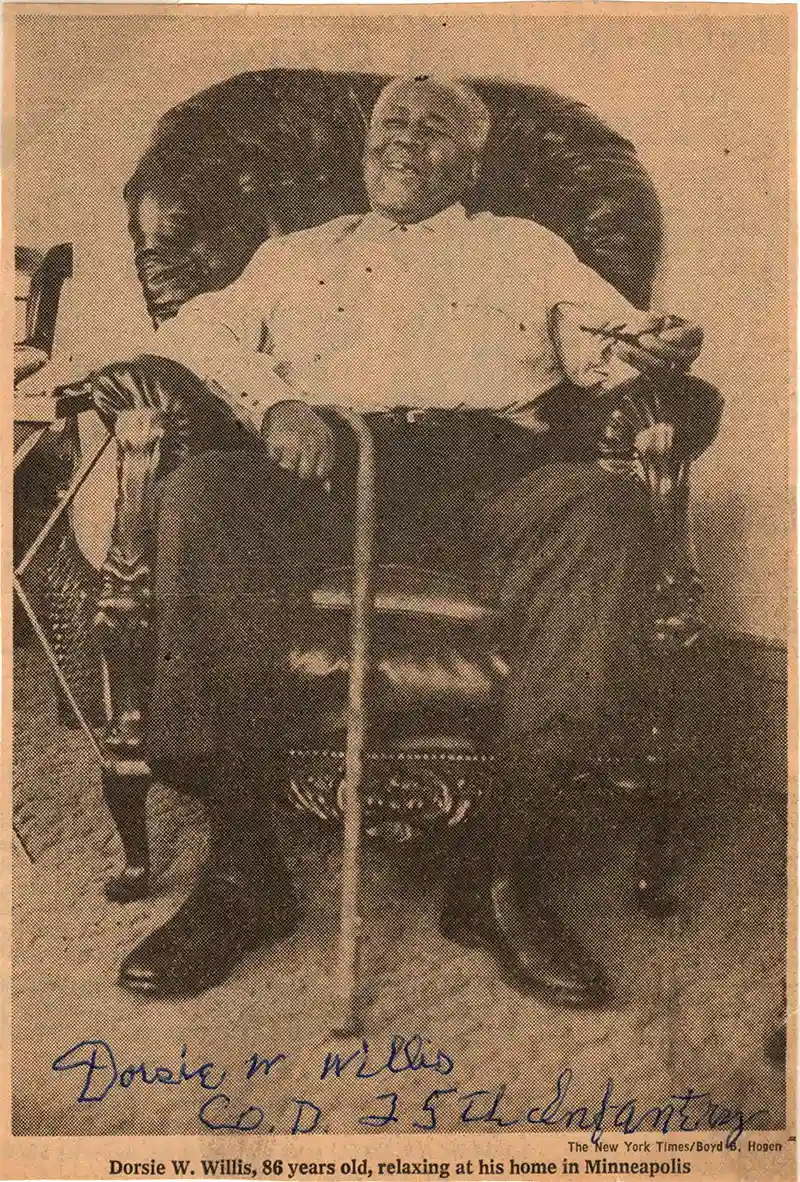
Dorsie W. Willis was a private in D Company, First Battalion, Twenty-Fifth Infantry. He was nineteen when the order reached him. He was eighty-six when a reporter came to his house on Minnehaha Avenue and asked him what it had cost.
He had lost his discharge paper years before. He recited its wording from memory anyway, that Dorsie Willis was discharged from the Army of the United States without honor, and forever debarred from enlisting in the Army or Navy or from holding any civilian employment under the Government. A check of his file at the National Archives showed his memory was exact. He had carried those words for sixty-six years.
I did figure the world owed me an opportunity to earn a living myself. But they took that away from me. That dishonorable discharge kept me from improving my station. Only God knows what it did to the others.
Dorsie W. Willis, to The New York Times, 31 December 1972
In a separate interview a month earlier he was more specific about the mechanism.
That has kept me from getting any kind of a job where I had to furnish references. It forced me into shoe shining.
Dorsie W. Willis, Los Angeles Times, 2 December 1972
He shined shoes in the barber shop of the Northwestern Bank Building for fifty-nine years. He opened it every morning, swept the hair off the floor, brushed the lint off coats, and closed at night. A shine cost ten cents and a tip when he started in 1913. He supported his wife, raised his son, and at fifty went $2,850 into debt to buy his own house.
Willis says “dishonorable.” The 1906 action was a discharge without honor, not a dishonorable discharge adjudged by a court-martial — a distinction that mattered a great deal to the War Department and not at all to an employer asking for references. Shining shoes is honest work and he did it well for fifty-nine years. The injury he described was not the work. It was that the choice had been taken from him by a finding no one had ever made against him by name.
What correction could and could not repair
On 28 September 1972 the Secretary of the Army, Robert F. Froehlke, called the incident a gross injustice and changed all 167 discharges to honorable. The amended order added a condition. “No back pay, allowances, benefits or privileges shall accrue by reason of the issuance of this order to any heirs or descendants.” The Army made no effort to find the men. When Congress proposed paying them, the Army objected. “Unless the survivors initiate an inquiry,” it told Congress in 1973, “the Secretary of the Army has no way of locating those that may be still living.”
One was. In February 1973 Willis received his corrected certificate and an Army apology at a public ceremony in Minneapolis. Representative Augustus F. Hawkins of California pressed for compensation, and on 6 December 1973 President Nixon signed a law paying $25,000 to each surviving soldier and $10,000 to each unremarried widow. The check was handed to him in Minneapolis in January 1974.

View the high-resolution scan → 2,560 × 1,838 · 607 KB
He was eighty-seven. He had been discharged at nineteen. A corrected record, a public apology, an act of Congress and an actual payment are four different things, and not one of them is the sixty-six years.
What Washington laughed at

Two months after the order, at the Gridiron Club’s private dinner for the President and official Washington, the souvenir book said Roosevelt was busy “killing bears, firing coons.” Two accounts of that night put the same slur in Roosevelt’s own mouth. Read the full record of the Gridiron dinner.
Three people
Some of what is known about them rests on photographs and newspaper material still in copyright, which ICML links to rather than reproduces.
Dorsie W. Willis (1886–1977) gives the clearest first-hand account of what the discharge did over a lifetime. Recorded in some sources as Dorsey.
First Sergeant Mingo Sanders had served more than twenty-five years when the order reached him. His case shows that length of service and rank were no protection. The order was collective, and so it took him too.
Senator Joseph B. Foraker of Ohio pressed the Senate to examine the case, against a President of his own party. Oversight in this instance meant confrontation. It did not mean vindication, and he was not the only one who acted — the soldiers, their families, Black newspapers and civil-rights organizations were pressing the case throughout.
Timeline
- 15 March 1893The Adjutant General's Office publishes Circular No. 9, creating a printed blank for discharge “without honor” and naming four grounds for its use. Only one involves a court-martial.
- 13–14 August 1906Shots are fired in the streets of Brownsville, Texas, during the night. One man is killed and several are wounded. Townspeople accuse soldiers of the Twenty-Fifth Infantry, stationed at Fort Brown.
- Autumn 1906The Army investigates. The Inspector General reports that the firing was done by unidentified enlisted men of the Twenty-Fifth, and that the men of the command “appeared to stand together in a determination to resist the detection of the guilty.”
- 9 November 1906By the President's direction, an order discharges without honor practically every enlisted man of the Fort Brown garrison — 167 soldiers. No one is charged. No one is tried. They are barred from re-enlistment and granted travel pay.
- 12 December 1906A further order allows a discharged man to apply for re-enlistment if he submits evidence that he was not implicated and withheld nothing. Each application goes to the War Department for investigation. The burden of proof now rests on the soldier.
- 14 May 1908Oscar W. Reid, one of the discharged men, sues for the pay he would have earned. The District Court for the Southern District of New York gives judgment for the government.
- 1909The Supreme Court declines to disturb the result.
- 28 September 1972The Army announces that the Brownsville discharges will be corrected — sixty-six years later.
- 11 February 1973Dorsie W. Willis receives his corrected certificate and an Army apology at a public ceremony in Minneapolis.
- 6 December 1973President Nixon signs a bill giving Willis $25,000.
- 10 January 1974Willis, eighty-seven, receives the check from Army Col. William Baker in Minneapolis. Maj. Gen. DeWitt Smith calls him “a courageous, decent and honorable man.”
The government record
The government printed the whole case, including the order, the investigations, two courts-martial, three volumes of Senate hearings, the committee’s reports and twelve volumes of the Court of Inquiry. The Institute is publishing every page as a clean text edition, the text beside the image of the printed page, searchable, with a downloadable PDF. All 18 records are online. Each card opens the record.
The order and its defense, 1906


The Senate record, 1908 (S. Doc. 402, parts 1 to 6)
 S. Doc. 402, pt. 1 · 1908Summary Discharge, reprintedThe 1906 message and report, reprinted as the first part of the Senate’s record.Clean text edition online
 S. Doc. 402, pt. 2 · 1908Court-martial of Maj. Charles W. PenroseThe general court-martial of the battalion’s commander, San Antonio, February 1907.Clean text edition online
 S. Doc. 402, pt. 3 · 1908Court-martial of Capt. Edgar A. MacklinThe general court-martial of the officer of the day, San Antonio, April 1907.Clean text edition online
 S. Doc. 402, pt. 4 · 1908Senate hearings, volume 1Hearings before the Senate Committee on Military Affairs concerning the affray.Clean text edition online
 S. Doc. 402, pt. 5 · 1908Senate hearings, volume 2The hearings continue, including the testimony of the discharged soldiers.Clean text edition online
 S. Doc. 402, pt. 6 · 1908Senate hearings, volume 3The final volume of hearings, with the examination of General Garlington and the men’s individual records.Clean text edition online
The Senate’s reports and the reenlistment question, 1908
 S. Doc. 389 · 1908The Brownsville AffrayThe Inspector-General’s report, the President’s order and Special Orders No. 266 with the names of the men, the President’s messages, and the committee’s majority and minority reports, in one document.Clean text edition online
 S. Rept. 355 · 1908The committee’s reportThe report of the Senate Committee on Military Affairs, March 11, 1908.Clean text edition online
 S. Rept. 355, pt. 3 · 1908Views of Senators Foraker and BulkeleyThe two Senators who concluded that the weight of the testimony showed none of the soldiers took part in the shooting.Clean text edition online
 S. Doc. 430 · 1908Names of Enlisted Men Discharged, with Applications for ReenlistmentThe War Department’s list of the men discharged without honor who had applied to reenlist.Clean text edition online
The Court of Inquiry, 1909 to 1910 (S. Doc. 701, 12 volumes)
 S. Doc. 701, vols. 1–3 · 1910Court of Inquiry, volumes 1 to 3Report of the proceedings of the Court of Inquiry relative to the shooting affray, the court created by the Act of March 3, 1909.Clean text edition online
 S. Doc. 701, vols. 4–6 · 1910Court of Inquiry, volumes 4 to 6The court’s proceedings continue.Clean text edition online
 S. Doc. 701, vols. 7–9 · 1910Court of Inquiry, volumes 7 to 9The exhibits: the court’s instructions, the map of Brownsville, photographs, ordnance and target records, depositions and affidavits.Clean text edition online
 S. Doc. 701, vols. 10–12 · 1910Court of Inquiry, volumes 10 to 12The court’s proceedings and findings.Clean text edition online
The bill to correct the records, 1909 to 1911
 H.R. Rept. 2248 · 1909Certain Officers and Enlisted Men of the Twenty-fifth InfantryThe House Committee on Military Affairs’ report on S. 5729, the bill to correct the records and authorize reenlistment.Clean text edition online
 H.R. Rept. 2278 · 1909Certain Officers and Enlisted Men of the Twenty-fifth InfantryThe House Committee on Rules’ report setting S. 5729 for consideration.Clean text edition online
 S. Doc. 833 · 1911Reenlistment of Certain SoldiersThe Acting Secretary of War’s list of the men the court found eligible to reenlist.Clean text edition online
Beyond the government record
The printed record is only part of the story. These sections hold everything else on Brownsville, kept apart from the government record and from one another.
More government records
Official records outside the printed series above, from the Senate and the House. Each will be published in full.
- The Black Battalion: Speeches in the Senate of the United StatesSpeeches of Dec. 6 and 20, 1906; Jan. 3 to 21, 1907; and Apr. 14, 1908.Clean text edition online
- Twenty-fifth Infantry, Companies B, C, and D: Speech in the SenateMay 4, 1908.Government record, to be published in full
- To Discontinue the Enlistment of Negroes for Military Service: Speech in the House of RepresentativesJan. 8, 1907.Clean text edition online
- Act of March 3, 1909, creating the Court of InquiryCh. 265, 35 Stat. 836.Government record, to be published in full
In the courts: Reid v. United States
Oscar W. Reid, one of the men discharged without honor, sued the United States. The case went from the federal court in New York to the Supreme Court of the United States. Each opinion is published here in full.
- Reid v. United States, 161 F. 469District Court, Southern District of New York, May 14, 1908. Opinion of Judge Hough.Clean text edition online
- Oscar W. Reid v. United States: Opinion Rendered by Mr. Justice HoughThe same opinion as printed by order of the Senate. S. Doc. No. 486, 60th Cong., 1st Sess.Clean text edition online
- Reid v. United States, 211 U.S. 529Supreme Court of the United States, decided January 4, 1909.Clean text edition online
Contemporary defenses of the men
What the men’s defenders published at the time. These works are in the public domain and will be published in full.
- Preliminary Report of the Commission of the Constitution League on the Affray at BrownsvilleS. Doc. No. 107, 59th Cong., 2d Sess.Clean text edition online
- A Review of the Testimony in the Brownsville InvestigationNorth American Review 187 (April 1908), 550 to 558.Clean text edition online
Mary Church Terrell
Within days of the order she went to Secretary of War Taft and won a short suspension of the discharges. She took up the case of First Sergeant Mingo Sanders, interviewed him at her home, and wrote about the soldiers for years after. Her papers are at the Library of Congress.
- Mary Church Terrell Papers, on BrownsvilleEvery item in her papers that mentions Brownsville, in her letters, diaries, writings and scrapbooks. Each item below links to its page image.Library of Congress
- Mary Church Terrell Papers, on Mingo SandersEvery item in her papers that mentions Mingo, among them her sketch of First Sergeant Sanders.Library of Congress
- Appeal for Black TroopsThe Washington Post, November 18, 1906, on her appeal to Secretary Taft to suspend the dismissals.Library of Congress
- The Disbanding of the Colored SoldiersThe Voice of the Negro, December 1906.Library of Congress
- Letter to First Sergeant Mingo SandersDecember 8, 1906, inviting Sanders and Private Brown to meet her.Library of Congress
- Mrs. Terrell Hears PleaPress report of Sanders and Brown’s visit to her home, December 1906.Library of Congress
- A Sketch of Mingo Saunders, Late 1st Sergeant Co. B, Twenty-fifth InfantryHer account of interviewing Sanders at her home, from her typescript at the Library of Congress. Published in The Voice, March 1907.Clean text edition online
- Diary, January 8, 1908Her visit to Secretary Taft about the dismissed soldiers.Library of Congress
- Secretary Taft and the Negro SoldiersThe Independent, July 23, 1908.Library of Congress
- Diary, January 12, 1909Hearing Senator Foraker speak for the soldiers in the Senate.Library of Congress
- Taft Befriended Disgraced TroopsEvening Star, Washington, March 10, 1930.Library of Congress
- The Secretary of War Suspends Order Dismissing Colored Soldiers at My RequestDraft chapter of her autobiography, A Colored Woman in a White World (1940).Library of Congress
- Her Brownsville scrapbookThe clippings she kept on the discharges, 1906 and 1907, among them the poem Sergeant Mingo Sanders.Library of Congress
Magazines and newspapers
Coverage from 1907 to 1911, all in the public domain and to be published in full, with the newspaper clippings already in the Archive.
- Dishonorably DischargedHarper’s Weekly, January 12, 1907, cover.Clean text edition online
- Athens and BrownsvilleThe Crisis 1, no. 1 (November 1910), 13.Clean text edition online
- Newspaper clippings in the ArchiveEvery newspaper and magazine item on Brownsville in the Archive, oldest first.Open
Correction and compensation, 1972 to 1977
The Army changed the discharges to honorable in 1972. Congress then compensated the last survivor, Dorsie W. Willis.
- Pending Non-Service-Connected Pension LegislationHouse Committee on Veterans’ Affairs, Subcommittee on Compensation and Pension, hearing of June 14, 1973, pp. 1215 to 1240.Clean text edition online
- $25,000 Voted for Survivor of Falsely Accused G.I. UnitThe New York Times, August 5, 1973.In copyright, cited
- Family of Black Victim in 1906 Texas Raid Recalls StigmaThe New York Times, February 8, 1977.In copyright, cited
- Dorsie W. Willis, 91, Victim of Army BiasThe New York Times, August 25, 1977.Quoted and linked
Books and scholarship
Works still in copyright. Each title links to its publisher, a library record or the journal. The Institute never reproduces them.
- The Brownsville RaidNew York, W. W. Norton. Reissued by Texas A&M University Press, 1992.In copyright, linked
- The Brownsville Affair: National Crisis and Black ReactionPort Washington, N.Y., Kennikat Press.In copyright, linked
- The Senator and the Sharecropper’s Son: Exoneration of the Brownsville SoldiersCollege Station, Texas A&M University Press.In copyright, linked
- The Brownsville RedemptionForeword by Bettye Foster Baker. Vulpine Press.In copyright, linked
- Buffalo Sergeant: First Sergeant Mingo SandersEnlisted Records.In copyright, linked
- The Bully Pulpit: Theodore Roosevelt, William Howard Taft, and the Golden Age of JournalismNew York, Simon & Schuster.In copyright, linked
- The Brownsville Episode and the Negro VoteMississippi Valley Historical Review 44, no. 3, 469 to 493.In copyright, linked
- President Theodore Roosevelt and the Negro, 1901–1908Journal of Negro History 47, no. 3, 169 to 182.In copyright, linked
- Brownsville: The Reaction of the Negro PressPhylon 33, no. 2, 153 to 160.In copyright, linked
- The Brownsville Raid’s 168th Man: The Court-Martial of Corporal KnowlesSouthwestern Historical Quarterly 93, no. 1, 45 to 59.In copyright, linked
- Prelude to Brownsville: The Twenty-Fifth Infantry at Fort Niobrara, Nebraska, 1902–06Great Plains Quarterly 16, no. 2, 95 to 106.In copyright, linked
- Brownsville RevisitedMaster’s thesis, Louisiana State University.In copyright, linked
Beyond the documents
The men
The 167
Every man named in Special Orders No. 266, company by company, and what became of each one. In preparation from the War Department’s own lists.
ComingThe testimony
Every witness
An index of every soldier and civilian who testified or swore an affidavit, with the pages where each one speaks. In preparation.
ComingThe press
1906 to 1973
The newspapers on the case, from the night of the shooting to Dorsie Willis’s honorable discharge.
Search the Archive →Washington
The Gridiron Dinner, 1907
The night Senator Foraker confronted the President over Brownsville in front of the capital’s press.
Read →Washington
James E. Watson on Roosevelt
The House whip’s memoir of the President, unsparing about how he regarded the law. Watson was at the Gridiron dinner of 1907.
Read →About this edition
Word for word
The text follows the printed original, with its spelling, punctuation and errors. Every page is read against its image twice, and doubtful readings are settled by a person against the page image.